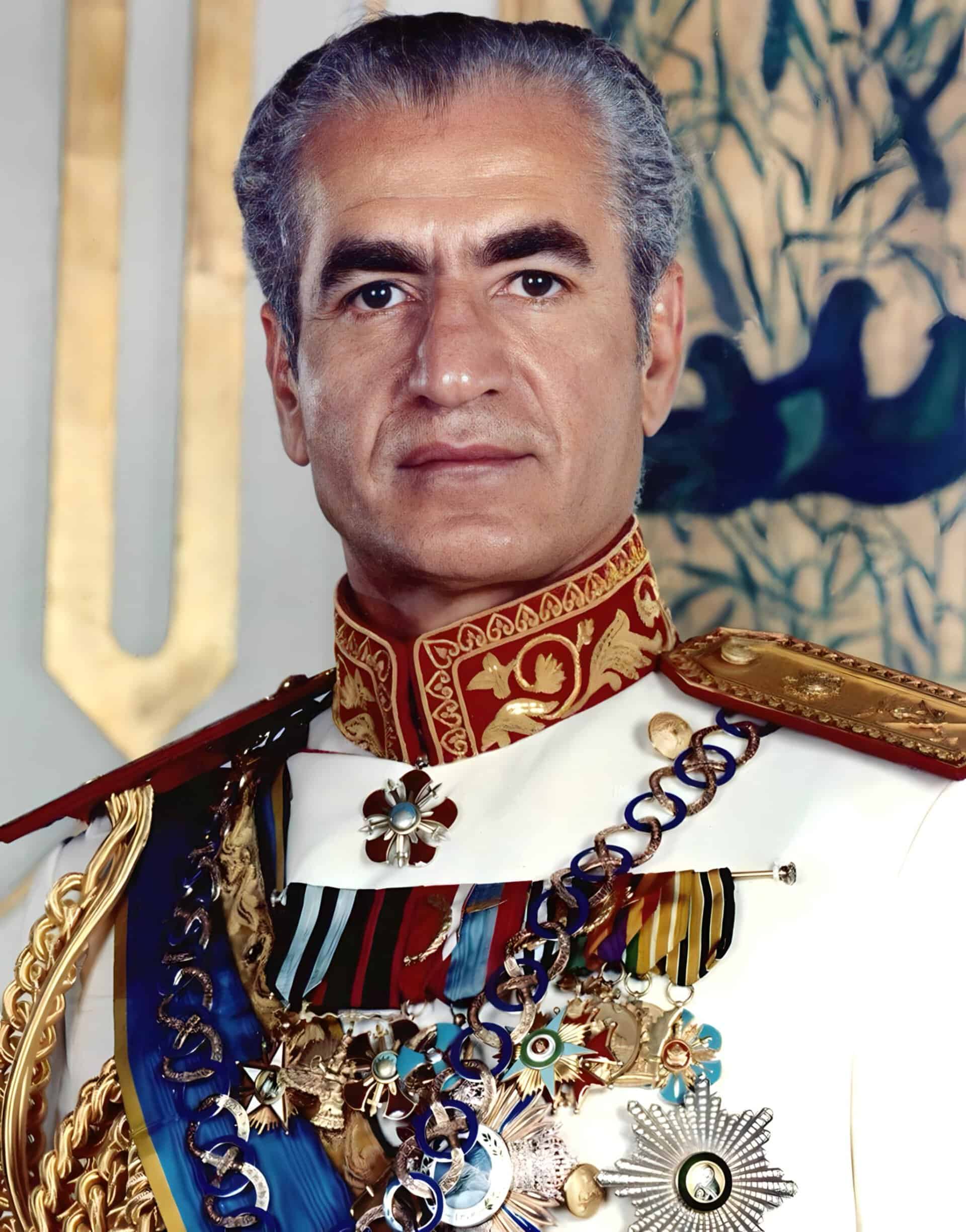
Mohammad Reza Shah

Early Life and Education
Mohammad Reza Pahlavi was born in Tehran on October 26, 1919, as the first child of Reza Khan and his wife Nimtaj. Interestingly, he had a twin sister, Ashraf, born four hours later. During his early years, he was formally proclaimed Crown Prince of Persia in 1926 after his father’s rise to the Peacock Throne.
Moreover, while Reza Shah focused on modernizing Iran—including renaming the nation from Persia to Iran and building a Western-aligned government—Mohammad Reza was educated abroad at the prestigious Le Rosey boarding school in Switzerland. Upon returning to Tehran, he continued his studies at the Military College, preparing for leadership. In addition, this early exposure to Western education significantly shaped his vision for Iran’s future.
Marriage and Early Challenges
In 1939, Mohammad Reza married Princess Fawzia of Egypt, with whom he had a daughter, Princess Shahnaz. Soon after, World War II reached Iran’s borders, as British and Soviet soldiers invaded the country to prevent German influence. Consequently, Reza Shah abdicated, and Mohammad Reza succeeded him as Shah on September 16, 1941.
During this period, Iran faced political instability and foreign pressure. Additionally, the young Shah had to navigate a delicate balance between internal factions and external powers. Nevertheless, these early challenges strengthened his political acumen.
Cold War Politics and Rising Influence
The post‑war era quickly drew Iran into the emerging Cold War. After the Soviet-backed Azerbaijan crisis in 1946, the Shah strengthened ties with Western powers, therefore positioning Iran against communist expansion. During this time, he also survived an assassination attempt in 1949, which underscored the volatility of his early reign. Furthermore, these experiences reinforced his determination to modernize and stabilize the country.
The 1953 Crisis and Return to Power
In 1951, Prime Minister Mohammad Mossadeq nationalized the Iranian oil industry, angering Britain and triggering a political crisis. As a result, tensions between the Shah and Mossadeq escalated. Eventually, in August 1953, a coalition of the Iranian army, bazaar merchants, and senior clerics ousted Mossadeq, fearing a communist takeover.
During this turmoil, the Shah briefly went into exile. However, he soon returned to Tehran, reinforced by Western support. Consequently, his authority was consolidated, and Iran’s alignment with the West strengthened. Moreover, this event marked a turning point in modern Iranian politics, setting the stage for ambitious reforms.
White Revolution and National Transformation
In the early 1960s, the Shah launched the White Revolution, a sweeping program of social and economic reforms. Specifically, the reforms included land redistribution to peasants, expanding women’s rights, nationalizing forests and waterways, and forming literacy and health corps for rural areas. Furthermore, these initiatives aimed to modernize Iran rapidly and reduce traditional inequalities.
In addition, the White Revolution encouraged rapid industrialization and urban growth. Consequently, new factories, roads, schools, and hospitals transformed cities and provided new employment opportunities.
Nevertheless, conservative religious leaders strongly opposed the reforms. In June 1963, Ayatollah Khomeini led an uprising that was suppressed by the Shah’s forces. Although the revolt failed, it marked the beginning of growing unrest. As a result, the White Revolution sparked both modernization and political tension simultaneously.
Challenges, Opposition, and Exile
Despite economic success, political dissent continued to grow. Meanwhile, tensions escalated between the ruling regime and a coalition of religious conservatives, leftists, and students. Eventually, in January 1979, political pressure forced the Shah to leave Iran rather than risk further bloodshed.
He spent his final year seeking medical treatment and died of lymphoma on July 27, 1980, in Cairo, Egypt. Although he is remembered for modernization and reforms, his authoritarian rule and repression also contributed to the revolutionary movement that ended the Pahlavi dynasty. In addition, his legacy continues to spark debate about modernization versus authoritarianism in Iranian history.
Personal Life and Legacy
The Shah’s personal life included several marriages: first, to Princess Fawzia of Egypt (1939–1948), with whom he had one daughter; second, to Soraya Esfandiary (1951–1958), with no children; and third, to Farah Diba (1959–1980), with four children including Crown Prince Reza Pahlavi.
Ultimately, growing unrest and widespread protests forced him to leave Iran in January 1979. He died of lymphoma on July 27, 1980, in Egypt. Although he is remembered for modernization and reforms, his authoritarian rule and repression also contributed to the revolutionary movement that ended the Pahlavi dynasty. In addition, his legacy continues to inspire debate about modernization versus authoritarianism in Iranian history.
- Pahlavi Dynasty Overview: “Learn more about the Pahlavi Dynasty and its role in modern Iranian history.”
- Reza Shah the Great: “Mohammad Reza succeeded his father, Reza Shah the Great.”
- Crown Prince Reza Pahlavi II: “…his son Reza Pahlavi II became a prominent figure in exile.”
Head of the House of Pahlavi
Predecessor:
H.I.M. Mohammad Reza Shah Pahlavi (26 October 1919 – 27 July 1980; aged 60)
Successor:
H.I.H. Crown Prince Reza Pahlavi II
Spouses and Issue
- Fawzia Fuad of Egypt (5 November 1921 – 2 July 2013; married 1939–1948)
- Issue: Princess Shahnaz Pahlavi (born 27 October 1940)
- Soraya Esfandiary-Bakhtiari (22 June 1932 – 26 October 2001; married 1951–1958)
- Issue: None
- Farah Diba (born 14 October 1938; married 1959–1980)
- Issue:
- Crown Prince Reza Pahlavi (born 31 October 1960)
- Princess Farahnaz Pahlavi (born 12 March 1963)
- Prince Ali-Reza Pahlavi (28 April 1966 – 4 January 2011)
- Princess Leila Pahlavi (27 March 1970 – 10 June 2001)
- Issue:
Siblings
- Princess Shams Pahlavi (1917–1996)
- Princess Ashraf Pahlavi (twin sister, born 1919)
- Prince Ali Reza Pahlavi (1922–1954)
Parents
- Father: Reza Shah Pahlavi (15 March 1878 – 26 July 1944; aged 66)
- Mother: Tadj ol-Molouk Ayromlou (17 March 1896 – 10 March 1982; aged 85)
Personal Details
- Born: 26 October 1919, Tehran, Persia (Iran)
- Died: 27 July 1980 (aged 60), Cairo, Egypt