Jashn-e Mehregan
Mehregan Festival
Mehregan is one of the oldest and most magnificent festivals of ancient Iran. Rooted in the enduring traditions and beliefs of the Iranian people, this celebration symbolizes love, friendship, justice, faithfulness to one's word, and gratitude for the blessings of nature. Alongside Nowruz, Mehregan has long been regarded as one of the most important annual celebrations in Iranian culture, reflecting the profound connection between the people of Iran, the natural world, light, and timeless human values.
Mehregan is far more than a celebration marking the arrival of autumn. It represents an expression of the Iranian cultural and philosophical worldview, in which truthfulness, loyalty, justice, solidarity, and respect for nature hold a fundamental place. Throughout the centuries, this festival has endured as a symbol of Iran's cultural identity, preserving its significance within the collective historical memory of the Iranian people.
The Historical Origins of Mehregan
The name Mehregan derives from Mehr, also known as Mithra, an ancient Iranian divinity associated with covenants, truth, and the preservation of cosmic order. In the beliefs of ancient Iran, Mehr was regarded as a guardian of promises and righteousness and was closely associated with light.
In ancient Iranian culture, honoring one's commitments and remaining faithful to truth were among the fundamental principles governing individual and social life. Mehregan reflected these enduring values and celebrated the moral foundations upon which Iranian civilization placed great importance.
The origins of Mehregan extend deep into antiquity. Although direct historical evidence concerning the precise manner in which the festival was celebrated during the Achaemenid period remains limited, historical and literary sources attest to its significance in subsequent eras, particularly during the Sasanian Empire and the early centuries following the arrival of Islam in Iran.
Over time, Mehregan not only preserved its ceremonial importance but also developed into one of the most distinguished social and cultural celebrations of the Iranian people. It provided an occasion for gatherings, festivities, the affirmation of ethical values, and the appreciation of nature's abundance.
Mehregan: The Autumn Festival of Gratitude and Harvest
In the traditional Iranian calendar, each day of the month carried a specific name. The sixteenth day was known as Mehr. When the day of Mehr coincided with the month of Mehr, the occasion was celebrated as Mehregan, traditionally observed on the sixteenth day of Mehr.
Due to historical changes and differences in Iranian calendrical systems, however, the tenth day of Mehr is also recognized as the date of Mehregan in certain contemporary calendars.
While Nowruz heralded the rebirth of nature and the arrival of spring, Mehregan was associated with the coming of autumn, the completion of the agricultural harvest, and the abundance of the earth's blessings.
At this time of year, farmers gathered the fruits of months of labor, and communities came together to celebrate the harvest. Through festivities, thanksgiving, and family gatherings, people expressed their appreciation for the generosity of nature and the rewards of human effort.
From this perspective, Mehregan may be understood as a celebration of the earth's fertility, abundance, gratitude, and the dignity of human labor. It represents an enduring vision of harmony between humanity and the natural world.
Mehregan in the Shahnameh: The Victory of Fereydun over Zahhak
One of the most significant mythological traditions associated with Mehregan is the victory of Fereydun over Zahhak. Within Iran's epic heritage, this story represents the triumph of justice over tyranny and truth over injustice.
According to ancient Iranian legends, Zahhak was a tyrannical ruler whose reign brought suffering and oppression to the people. Eventually, Kaveh the Blacksmith rose against his injustice and, raising his banner, called upon the people to resist tyranny.
With the support of Kaveh and the people, Fereydun defeated Zahhak and brought an end to his oppressive rule. In Iranian legendary traditions, this victory became closely associated with the celebration of Mehregan.
Thus, beyond its associations with love and friendship, Mehregan also came to symbolize the ideals of justice, liberation from oppression, and the restoration of righteous leadership.
Ferdowsi, the great Persian poet, refers to the beginning of the month of Mehr and the celebration of Mehregan in his Shahnameh, within the account of Fereydun's reign:
On the auspicious day, at the beginning of Mehr,
He placed the Kayanian crown upon his head.
— Ferdowsi, Shahnameh (English rendering)
Beyond its literary and epic significance, this ancient narrative reflects the importance of justice, resistance to oppression, and the ideal of righteous kingship within Iranian culture.
The story of Fereydun and Zahhak belongs to Iran's mythological heritage and embodies moral principles and aspirations that have remained alive in Persian literature and cultural traditions throughout the centuries.
The Significance of Mehregan in Ancient Iran
Mehregan held a distinguished place throughout various periods of Iranian history. Alongside Nowruz, it was regarded as one of the most important annual celebrations and was associated with royal ceremonies, the presentation of gifts, elaborate festivities, and public gatherings.
Historical accounts describe traditions in which rulers wore ceremonial garments appropriate to the changing season and distributed gifts among members of the royal court and others. Such practices illustrate the importance of Mehregan within the social and cultural life of the Iranian people.
Abu Rayhan al-Biruni, the renowned Iranian scholar, discussed Mehregan and its associated customs in his celebrated work, Al-Athar al-Baqiya, also known as The Chronology of Ancient Nations. His writings preserve valuable accounts of the festival's place in Iranian traditions.
Mehregan did not disappear following the arrival of Islam in Iran. It continued to appear in Persian poetry, literature, and the writings of historians and scholars in subsequent centuries.
This remarkable cultural continuity demonstrates that Mehregan had evolved beyond a purely religious observance to become an enduring element of Iranian historical memory, national culture, and shared identity.
The Traditions and Ceremonial Table of Mehregan
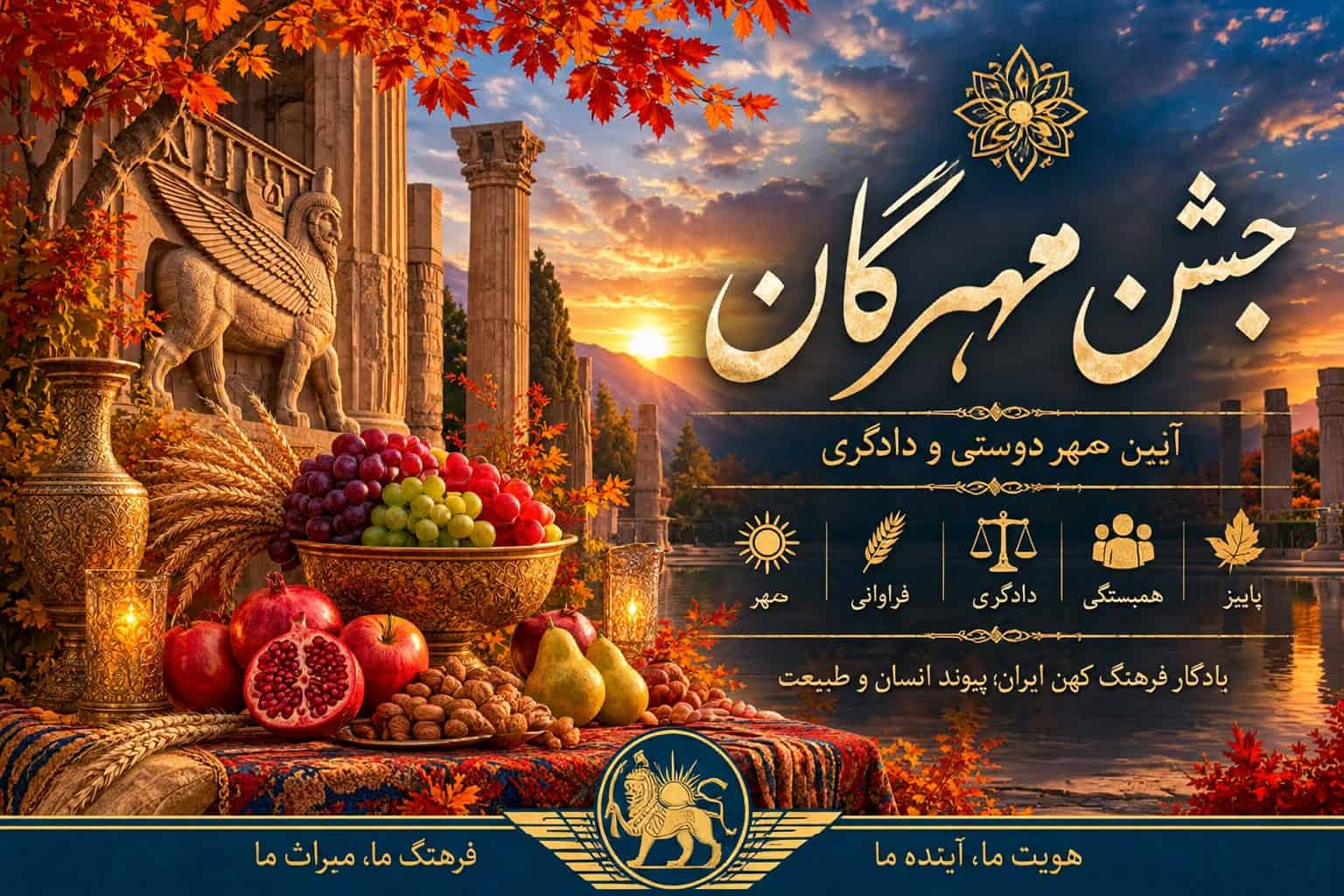
One of the most beautiful expressions of the Mehregan celebration is the preparation of a colorful ceremonial table adorned with seasonal fruits, traditional foods, and symbols of abundance and prosperity.
Decorated with the harvest of autumn and the blessings of nature, the Mehregan table reflects the ancient connection between the Iranian people, the earth, and the recurring cycles of life.
Common elements of Mehregan tables include pomegranates, grapes, apples, pears, wheat, dried fruits, nuts, and traditional sweets. The pomegranate, with its countless seeds, symbolizes fertility and abundance, while golden sheaves of wheat represent the earth's generosity and the rewards of agricultural labor.
In various Mehregan traditions, family gatherings, prayers, the recitation of hymns, music, joyful celebrations, and hospitality also hold an important place.
Families may gather in festive clothing, visit relatives and friends, share food and gifts, and celebrate the bonds of affection and friendship that bring communities together.
Although the customs associated with Mehregan differ among regions and communities, gratitude, collective joy, kindness, and respect for nature remain central themes in many of its celebrations.
Mehregan in Persian Culture and Literature
Throughout history, Mehregan has inspired generations of Iranian poets, writers, and thinkers. In Persian poetry, the festival is frequently mentioned alongside Nowruz and is associated with joy, prosperity, the beauty of autumn, and the splendor of traditional Iranian celebrations.
Great Persian poets, including Rudaki, Manuchehri, and Farrukhi Sistani, referred to Mehregan in their works, portraying the festive atmosphere, ceremonial traditions, and joyful spirit associated with the occasion.
The enduring presence of Mehregan in Persian literature demonstrates the festival's importance in the cultural and social life of the Iranian people.
Persian poetry and literary traditions have played a vital role in preserving the memory and significance of Mehregan, helping transmit this remarkable cultural heritage from one generation to the next.
Mehregan's Recognition by UNESCO
One of the most significant developments in the modern history of Mehregan was its inclusion on UNESCO's Representative List of the Intangible Cultural Heritage of Humanity.
In December 2024, the Ceremony of Mehregan was inscribed on this prestigious international list through a joint nomination submitted by Iran and Tajikistan.
In recognizing Mehregan, UNESCO emphasized the festival's connections with the autumn harvest, gratitude for nature's blessings, the strengthening of social solidarity, and the transmission of cultural traditions between generations.
This international recognition represents an important step toward preserving and promoting one of the enduring traditions of the Iranian cultural world. It also highlights the importance of safeguarding this valuable heritage for future generations.
Mehregan in the Modern World
Today, Mehregan continues to be celebrated by Zoroastrian communities and admirers of Iranian culture, both within Iran and throughout the world.
The festival provides an opportunity for families to gather, introduce younger generations to the traditions of their ancestors, and celebrate the richness of Iran's cultural heritage.
For Iranians living beyond the borders of their homeland, Mehregan holds particular significance. It offers an occasion to preserve cherished traditions and to pass on the language, culture, and identity of Iran to children and future generations.
In a world experiencing rapid social and cultural transformation, celebrations such as Mehregan strengthen the connection between past and present.
They remind Iranians, wherever they may live, of the shared cultural roots and enduring traditions that continue to unite them across generations and geographical distances.
Preserving the Ancient Traditions of Iran
Mehregan, like Nowruz and Tirgan, represents an invaluable part of Iran's cultural heritage and historical identity.
The festival reflects the profound importance of kindness, truthfulness, loyalty, justice, and respect for nature within the Iranian cultural tradition.
Preserving Mehregan is not merely an act of remembering an ancient celebration. It is also an opportunity to reflect upon the principles and values that have shaped Iranian civilization throughout the centuries.
These enduring ideals continue to inspire solidarity, friendship, mutual respect, and hope for the future.
Mehregan reminds us that Iran's heritage is not confined to historical monuments, magnificent architecture, works of art, or ancient manuscripts. It also lives through the customs, celebrations, beliefs, and traditions that generations of Iranians have preserved and passed down through time.
By celebrating Mehregan today, we honor not only one of Iran's oldest traditions but also the timeless values of love, justice, gratitude, solidarity, and devotion to Iran—values that remain inseparable from the cultural identity of the Iranian people.
Mehregan: An Enduring Cultural Legacy
Mehregan is a celebration of humanity's connection with nature, the sacred importance of honoring one's word, and the enduring ideal of justice triumphing over tyranny.
From ancient times to the present day, this remarkable festival has carried a message of friendship, enlightenment, gratitude, and unity.
Understanding and celebrating Mehregan represents an important contribution to preserving Iran's cultural identity and passing the invaluable legacy of our ancestors to future generations.
Happy Mehregan!
May love and friendship, enlightenment, justice, peace, and prosperity always accompany Iranians, wherever in the world they may be.